
I have to admit, every three years, when I hear the first scripture reading for the first Sunday of Advent, I struggle. We hear, just a few lines into the passage from Isaiah, “Behold, you are angry, and we are sinful; all of us have become like unclean people, all our good deeds are like polluted rags; we have all withered like leaves, and our guilt carries us away like the wind” (Is 64:6). To be honest, hearing about an angry God who I can’t please isn’t how I like to begin my Advent preparations and prayer.
Especially as a woman, I’ve spent a lot of my life absorbing and trying to work against the messaging that comes, consciously and not, from the culture surrounding me. In my adolescence and young adulthood, my internal dialogue often centered around shortcomings, faults, and things that just weren’t “good enough” about me. My perfectionism usually ran the show, reminding me that I wasn’t outgoing enough, smart enough, religious enough, thin enough, athletic enough, giving enough, a good enough friend or sister or daughter. If I never approved of myself, then I knew with certainty that God didn’t, either. Growing up steeped in Catholic circles, I knew God loved me, but still, the idea of being a flawed sinner rang out more strongly in my psyche.
When I was a graduate student in my late 20s, I had the opportunity to journey through the Spiritual Exercises over a nine-month period. While some of my previously held ideas about God and self had been evolving and changing prior to this time, the Exercises caused a seismic, foundational shift in my faith and my connection to God.
The most powerful turning point occurred during one spiritual direction meeting where I was (unsurprisingly) being hard on myself. I don’t remember exactly what I said, but in response, my director invited me to close my eyes and to recall my favorite picture of myself from my childhood. Then, she asked me to envision holding that little girl–a toddler with white-blonde pigtails, holding a shovel and sitting in our backyard garden–on my lap and talking to her like I talked to my present-day self. “I couldn’t talk to a child that way,” I responded. With gentleness, my director said, “Exactly. And God could never talk to you that way, even in your hardest moments.”
I was overcome with emotion, with tears welling over and rolling down my cheeks, with the realization of a God who loves me as I would love a child, who sees me in my fullest but still embraces me and extends to me immense grace as I strive to become who I am created to be. While I’d gone through the meditations and prayers from the First Principle and Foundation and the First Week of the Spiritual Exercises earlier, it was at this moment that I finally felt the magnitude of what it meant to be a loved sinner.
As time has gone by, I have learned so much about how to give myself the grace that God extends to me. It still takes conscious effort to hold at once the truth of being flawed and always a work in progress alongside the truth of being deeply, wholly, unconditionally loved by God. I don’t do it perfectly. Yet that moment with my spiritual director many years ago still shapes how I understand myself and my relationship with God, and that understanding ripples out into all I do, into how I am in relationship with my spouse, my children, my family and friends, my colleagues. We all come up short, but we are all good, we are all trying, and we are all deserving of God’s love and the love of one another.
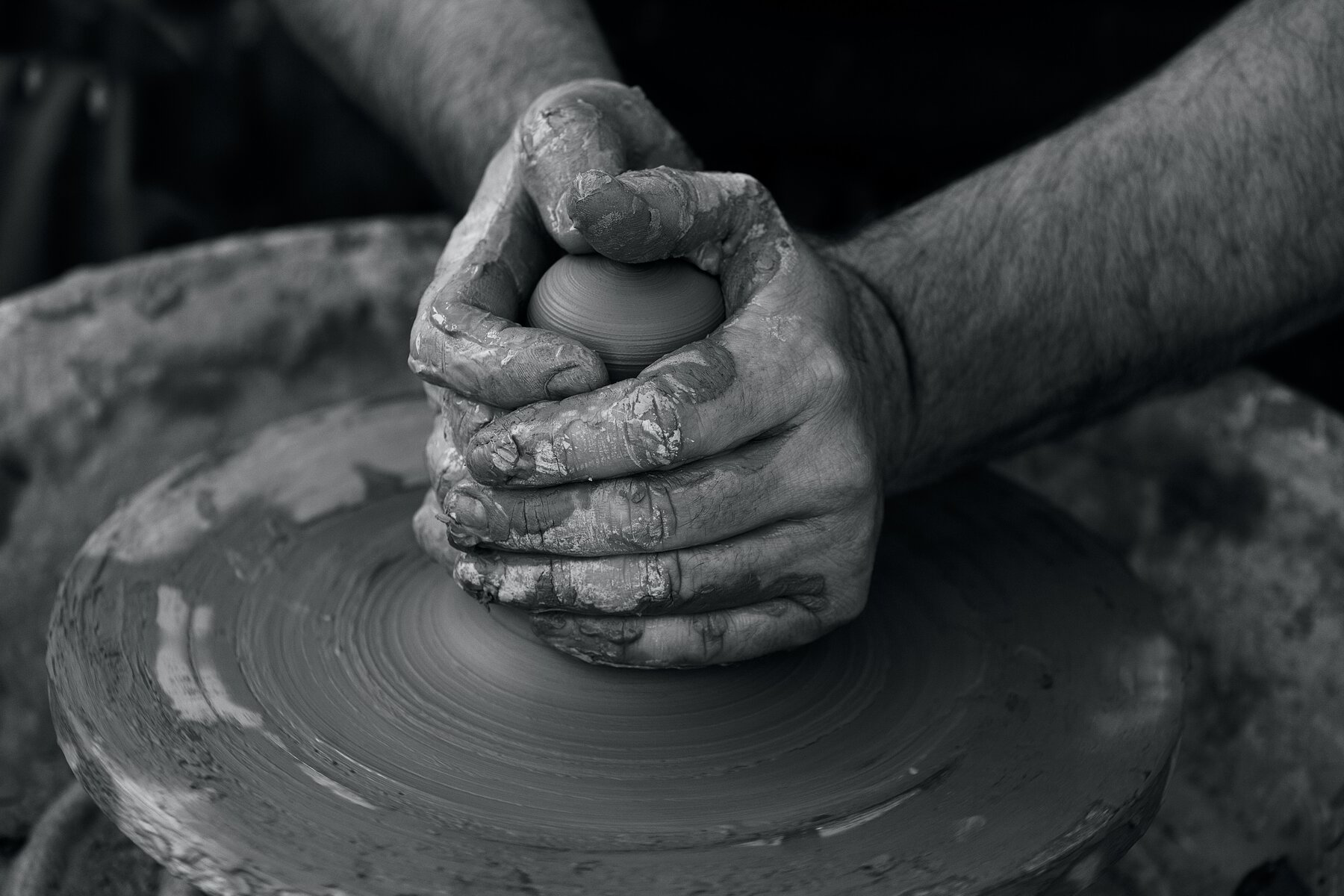
Going back to today’s reading from Isaiah, it’s almost like I hold my breath awaiting the last verse. There, I am reassured, hearing something that does resonate with me: God, our Creator, acting as the potter, shaping our very selves and our lives into beautiful works of love held in God’s hands (Isaiah 64:8). My imperfections, flaws, growing edges, sins–whatever I want to call them–will never be big enough to stop God from loving me and from continually shaping and molding me into something more than I could ever imagine. The same is true for each and every one of us, God’s children; God knows all of us and loves us immeasurably, deeply, because of and in spite of the multitudes we hold.
As we begin this season of preparation for Christ’s coming into our world, human as we are, may we each find ways to listen to the entirety of Isaiah’s words, trusting that God is always at work preparing us to receive Jesus into our lives and to walk more fully as his disciples.
Going Deeper Together:
- Consider praying with the following scriptures.
- Isaiah 64:7 - “Yet, Lord, you are our father; we are the clay and you our potter: we are all the work of your hand.”
- Jeremiah 18:1-6 - “This word came to Jeremiah from the Lord: Arise and go down to the potter’s house; there you will hear my word. I went down to the potter’s house and there he was, working at the wheel. Whenever the vessel of clay he was making turned out badly in his hand, he tried again, making another vessel of whatever sort he pleased. Then the word of the Lord came to me: Can I not do to you, house of Israel, as this potter has done?—oracle of the Lord. Indeed, like clay in the hand of the potter, so are you in my hand, house of Israel.-
- Listen to this reflection from Pray As You Go about being a “loved sinner.”
- Use Joyce Rupp’s words, “A Handful of Dough Made Holy,” from her book, Fresh Bread and Other Gifts of Spiritual Nourishment, in your reflection, drawing on another metaphor of God as one who shapes and molds us.
- Registration is still open for We are Not Alone: An Online Advent Retreat.This first week’s theme is “We are Fully Seen”. Use downloadable resources on your own or with an online Community.
Kristen Schenk
Kristen has been deeply shaped by Ignatian spirituality during her time as an undergrad at St. Louis University, a Jesuit Volunteer in Belize City, and a graduate student at the Institute of Pastoral Studies at Loyola University Chicago. She has worked in Catholic parish ministry, community organizing, spiritual direction, volunteer support and formation with Jesuits Volunteer Corps, and ministry with people with developmental/intellectual disabilities. She spent her most recent professional chapter as a pediatric hospital chaplain and now works in chaplain research. Kristen is passionate about accompanying others through the highs and lows of their lives and spiritual journeys and about joining with others to co-create a Church and world with greater justice, equity, and inclusion for all. She lives in Chicago with her spouse Patrick and their three young sons.

Comments
Loading comments...
Leave a comment